Prohibition Poison Program: The 1926 Law That Killed Drinkers
Christmas Eve, 1926. A man staggers through the doors of Bellevue Hospital in New York.
His eyes are wide. He is screaming that Santa Claus is behind him with a baseball bat.
The nurses think he is drunk. They lay him down.
Within an hour he is dead.
Then another man arrives. Then another. Then a woman. Then a young factory worker who had been dancing at a Christmas party a few hours earlier.
By dusk on Christmas the ward has counted more than sixty people desperately sick from alcohol. Eight of them are dead.
The newspapers call it bad whiskey. Washington calls it the drinker’s own fault.
New York City’s chief medical examiner, a quiet, exact man named Charles Norris, walks into the examination room, looks at what is left of these people, and says a sentence that still sits in the American record.
The United States government did this. And he can prove it.
This is the Prohibition poison program they sanded out of the civics book.
Drinking was never the crime. The marketplace was.
To understand what Norris found on those tables, you have to go back six years.
January 16, 1920. Midnight. Church bells. Temperance societies in the street. The 18th Amendment takes effect.
Manufacture, sale, and transport of alcohol are now illegal.
Here is the first thing school left out. Drinking itself was never made illegal. If you already had whiskey locked in a cellar that night, you could legally drink every drop of it for the rest of your life.
The crime was the market. Not the glass.
The second thing school left out: the same week Prohibition began, the bootleggers were already waiting. The moment alcohol became illegal, it became the most profitable commodity in the history of American crime.
No senator was ready for what came next. No president either.
Americans did not stop. They drank more.
Within weeks, something the men who wrote the amendment never planned for.
Americans did not become sober. They drank more. Forbidden things have a way of doing that.
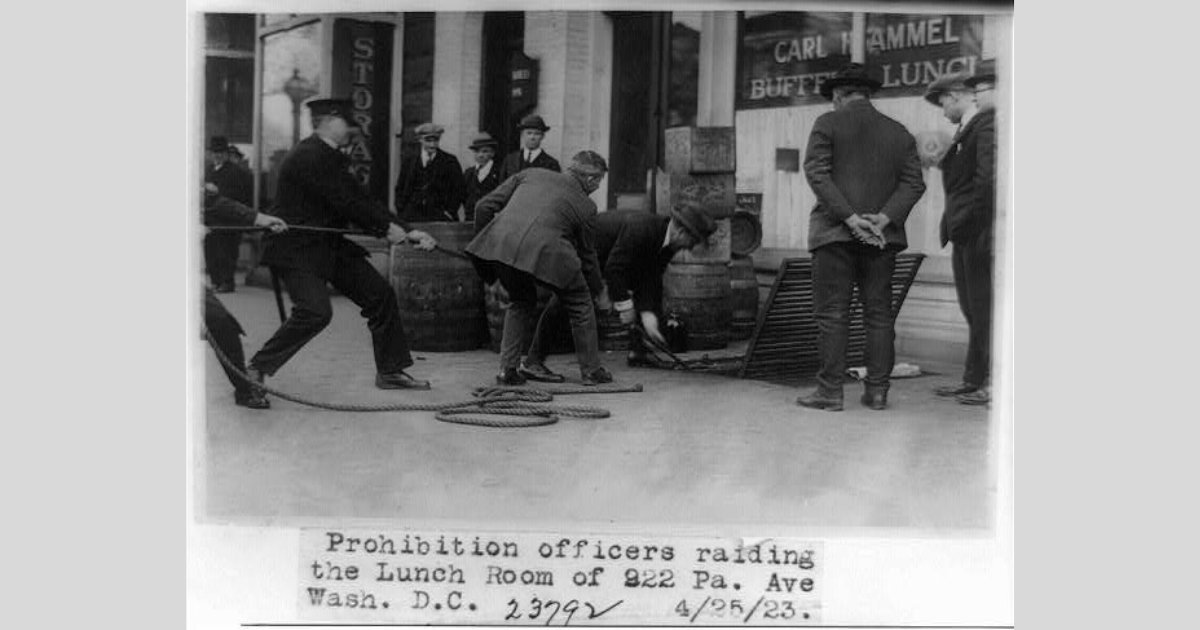
Speakeasies opened behind bookcases and false walls. By 1925, New York City alone was estimated to have about thirty thousand of them. That is roughly twice the number of legal bars that had existed before the law.
The amendment did not build a dry republic. It built a black market worth hundreds of millions of dollars.
Into that market walked organizations more powerful than many city halls.
Washington watched. Then it made a choice so cold that most Americans did not hear the full version for decades.
They did not poison the corner bar. They poisoned the supply the poor would steal.
Industrial alcohol — the kind used in paint, solvents, antifreeze — was still legal to manufacture.
Bootleggers learned they could steal it by the millions of gallons, hire chemists to strip the worst of it, flavor it as gin or whiskey, and sell it on the street.
The government knew.
Instead of closing the industrial tap, federal officials ordered the alcohol made more deadly on purpose.
Manufacturers were told to load it with chemicals no person should swallow. Methanol, which the body turns into formaldehyde and then formic acid. Kerosene. Benzene. Chloroform. Mercury salts. Formaldehyde. Nicotine.
TIME printed the 1926 formula the way you print a warning, not a toast. Three ordinary drinks of the new mix, the magazine said, could blind a person.
When bootleg chemists learned to filter the old recipe, Washington did not back off. In 1926 it doubled the poison load. The New York Times headline did not whisper. Government to Double Alcohol Poison Content.
They knew people were drinking it.
Did you know? Denaturing industrial alcohol did not start in 1926. Tax rules had used wood alcohol for years. What changed in the mid-1920s was the decision to make the mix far more lethal after bootleggers kept redeeming it.
The men in charge said the quiet part out loud
Wayne Wheeler was the most powerful figure in the temperance machine and a principal architect of the Volstead Act. Asked about the dying, he answered:
The person who drinks this industrial alcohol is a deliberate suicide.
He opposed additives that would only smell bad or taste foul. He wanted the load to stay lethal. National Geographic still carries the line.
Seymour Lowman, Assistant Secretary of the Treasury overseeing Prohibition enforcement, looked at the city death lists and said the people dying from poison hooch were on the fringes of society and were dying off fast.
Then he said the sentence Norris never forgot.
If that produces a sober America, a good job will have been done.
A senior official of the United States called the poisoning of his own citizens a good job.
The dead were not Capone’s men
Norris did not frighten easily. He had built New York’s medical examiner’s office into the most serious forensic shop in the country.
What came through his rooms in 1926 and 1927 still shook him.
The dead were not gangsters.
They were a 37-year-old garment worker from Delancey Street who had gone to a holiday party. An iron worker named Patrick who went blind on Christmas Eve. Factory hands. Mothers. Young men who bought the cheapest drink the corner would sell.
The rich were not on those tables.
The wealthy drank pre-Prohibition cellar stock, Canadian imports, or pharmacy rye obtained with a doctor’s script. The people with coins in a pocket drank whatever the block was pouring.
That was the government’s poison.
In late December 1926 Norris walked into a press room and said what no cabinet officer wanted in print.
The United States government must be charged with the moral responsibility for the deaths that poisoned liquor causes.
Then he asked the question that still has no clean answer.
Who poisoned it?
The New York Times printed his charge on December 28, 1926. By then the city’s holiday death count was already climbing past the eight bodies from Christmas Day.
Deborah Blum, who reconstructed the forensic files in The Poisoner’s Handbook, later estimated that about 10,000 Americans died from tainted liquor across the Prohibition years. Snopes rates the popular version of that claim as a mixture: the government did add lethal denaturants; it did not ladle poison into bottles labeled as legal whiskey. The dead still stacked up.
Watch the documentary
Reading a death list is one thing. Hearing how officials called it a good job is another.
The film from Old America Was Insane walks the same record: Bellevue on Christmas Eve, Wheeler, Lowman, jake leg, Capone’s kitchen, and Utah’s vote in 1933.
Jake leg: the other government “fix”
The denaturing program was not the only way the war on alcohol wrecked ordinary bodies.
In 1930, Jamaica ginger extract — a legal drugstore tonic that was mostly alcohol — had become the poor man’s drink across the South and Midwest.
Washington, wise to the loophole, ordered a new test that would make the extract too thick to swallow as liquor.
Two Boston men, Harry Gross and Max Reisman, found a way around the test. They added an industrial plasticizer, triorthocresyl phosphate, so the product would pass on paper.
Within two weeks of their batch hitting the market, men across the country lost feeling in their feet. Then their hands. For most, the paralysis stayed.
Doctors later estimated 30,000 to 50,000 Americans were left disabled. They called it jake leg. The walk gave them away: a tap-click, tap-click on the pavement.
Veterans who had come home from France sat indoors in towns like Johnson City, Tennessee, too ashamed to be heard.
Newspapers would not stay with the story long enough to force a reckoning. Blues records did. Ishman Bracey sang that it was the doggonest disease he had heard of since he was born. You go numb in front of your body.
Tens of thousands of people. Permanently damaged. A footnote in most textbooks.
That is the work of this site: the chapters a country files under “noble experiment” and hopes you will not open.
Capone fed the city Washington would not
While the working class drank the denatured supply, one man decided to sell them what they wanted and, later, to feed them.
Alphonse Capone. Brooklyn-born son of Italian immigrants. By his mid-twenties he ran Chicago.
Federal agents put his bootleg alcohol take at about $60 million a year — close to a billion in today’s money — from liquor alone.
The part almost nobody leads with happened in the winter of 1930.
The Depression had Chicago by the throat. Men stood in line for a bowl of soup. The federal government offered little that reached the sidewalk.
Capone opened a kitchen at 935 South State Street. The sign was plain: Free Soup, Coffee and Doughnuts for the Unemployed.
Every day, breakfast, lunch, and dinner. About 2,200 hot meals. No questions. The Library of Congress still holds the photographs.
On Thanksgiving 1930 the kitchen fed about 5,000. Beef stew, not turkey. A thousand birds had been stolen from a store. Capone feared the blame and changed the menu.
People in that line told reporters this man — the same man who ordered murders — was doing more for their survival than the President.
When asked about the empire, Capone said nobody in that town had wanted Prohibition. The city had voted six to one against it. Somebody had to throw liquor on the thirst. Why not him?
They never convicted him of the crimes that built the fortune
For all the power and all the cash, Capone was never convicted of a single murder. Never convicted of bootlegging. Never convicted of the bribery that kept the machine wet.
The government finally took him in 1931 for tax evasion. He had not paid income tax on criminal earnings.
That is the turn that remade American enforcement. You do not always have to prove the body. You prove the money. The IRS as a weapon against the men murder charges could not touch was born in that prosecution. It is still the template.
Historians mention the last detail quietly. In prison, as neurosyphilis took his mind, Capone would call a name in the night. Jimmy. Possibly James Clark, one of the seven killed in the Saint Valentine’s Day Massacre.
Guilt or disease. Nobody can say. The businessman who said he only gave people what they wanted ended talking to a ghost.
Utah killed the noble experiment at 3:32 p.m.
December 5, 1933. 3:32 in the afternoon, Mountain Time, Salt Lake City.
Delegates vote on the 21st Amendment — full repeal.
Thirty-six states are needed. Ohio and Pennsylvania have already said yes. It comes down to Utah. A Mormon-majority state. The most religiously dry room in the country.
The vote is unanimous. Yes.
Telegraph wires go. Trucks that have idled outside warehouses all day finally move. Wet cities pour legal drinks that evening. Seattle had an emergency ordinance ready before Utah even voted.
People who had spent thirteen years drinking poison in the dark raised a legal glass.
The story still does not end there.
Mississippi kept statewide Prohibition until 1966 — thirty-three years after the rest of the country. Some American counties are dry now.
They called it the noble experiment.
Norris called it something else. In 1928 he published an essay titled “Our Essay in Extermination.” He did not use the word noble.
The government chose one name. The medical examiner chose another.
The thousands who died from poisoned alcohol never got to choose anything at all.
Old America was insane. The family that hid a daughter in an operating room is another chapter. More are on Stories.
If a date here is wrong, write oldamericainsane@gmail.com. It will be corrected in public.
This account follows contemporary newspapers, the medical examiner’s public statements, and later histories. Death totals from tainted liquor are estimates. Industrial alcohol was denatured by law; bootleggers then sold it as drink.
Sources
- National Archives — 18th Amendment
- National Archives — 21st Amendment
- New York Times, 28 Dec 1926 — Norris on moral responsibility
- New York Times, 30 Dec 1926 — Government to double alcohol poison
- TIME — Death from Drinking / 1927 denaturing formula
- National Geographic — government poison during Prohibition
- Snopes — 10,000 deaths claim
- Deborah Blum, The Poisoner’s Handbook; HNN excerpt
- Charles Norris, “Our Essay in Extermination,” North American Review, Dec. 1928
- HISTORY — Capone soup kitchen
- Library of Congress — Capone soup kitchen photo