Galveston Hurricane 1900
On September 8, 1900, about six thousand Americans died in a single night.
More than the Great Chicago Fire. More than the Johnstown Flood. More than the San Francisco earthquake. Those three, added together, still fall short.
Men who studied storms saw this one coming. They tried to warn the country.
The United States government blocked the warning. It blocked the word. It blocked the science.
Then the water came into the houses.
You were not taught this in school. That was not an accident.
This is the Galveston hurricane of 1900.
Galveston was not a fishing village
Most people picture a quiet Texas beach.
That is not what Galveston was in 1900.
It was the Wall Street of the South. The richest city in Texas. One of the richest in the country.
Texas’s first electric lights. First telephones. First opera house. First medical school. The Strand was granite and iron, the kind of street that wanted to look like New York.
The port shipped more cotton than any other harbor on earth. Steamships ran to Europe, Cuba, Mexico.
In the summer of 1900 the city was gilded and sure of itself.
That certainty is what killed it.
The best forecast on earth was sitting in Havana
The story does not start on the Texas sand. It starts in Havana.
Jesuit priests at the Belén Observatory had spent decades on hurricanes. Father Benito Viñes built the first tracking network in the Western Hemisphere. His successor, Father Lorenzo Gangoiti, watched this storm cross Cuba.
Halo around the moon. Blood-red dawn. Cirrus streaming north.
The signs said the storm would not curve toward Florida the way Washington wanted. It would cross the warm Gulf and hit Texas.
Gangoiti sent the warnings. Again. And again.
Washington did not let them through.
Willis Moore banned the word
The man at the top of the United States Weather Bureau was Willis Luther Moore.
He wanted American forecasts to own the hemisphere. He despised the Cuban work. He called it superstition. He accused the priests of stealing American data. He offered no proof that mattered.
After the Spanish-American War, Cuba sat under American occupation. Moore used it.
He got the War Department to block weather telegrams from Cuban observatories unless they came through the U.S. Bureau.
Gangoiti’s forecast — the most accurate hurricane call on earth that year — was legally stopped.
Then Moore made the second cut. His own men could not use the word hurricane without his personal say-so. He thought the word caused panic. An “unhappy impression” of the Bureau.
So when the storm left Cuba and entered the Gulf, it fell off the American map.
The water out there was about eighty-five degrees. The storm had days to become something else.
Saturday morning looked like a postcard
September 8. Clear sky. Warm salt air. Children in the street.
Tourists stood on the beach and called the surf grand. Young women from a business college in Marshall tried to hire a carriage just to see it better.
Isaac Cline, chief of the Weather Bureau office in Galveston, had been up before dawn. He stood on the sand and watched south swells while the wind still blew from the north.
Any trained man knew what that meant. The Gulf was being shoved from the other side. Something huge was offshore.
Cline broke the rule. He raised hurricane flags over the office without waiting for Washington. He drove a horse cart along the beach and told people to get to higher ground.
Galveston had seen storms. Streetcars still ran. Shops stayed open.
By noon the bridges to the mainland were under water. The island was an island in the worst sense. No one could leave.
The storm had not arrived yet.
The man with the flags had already told the city it was safe
Here is the detail that does not let go.
Nine years earlier, in 1891, Cline had published an article saying it was an absurd delusion to think a hurricane could seriously wreck Galveston.
City men who wanted a seawall lost that fight in part because of talk like his. The dunes that might have broken the first surge had already been scraped flat to fill lots.
On the morning of the eighth, Cline was riding the same streets trying to unsay his own words.
He trusted his house. Strong walls. Good ground. When the water rose he took in his pregnant wife Cora, his three daughters, his brother Joseph, and nearly fifty neighbors.
He trusted what he had built. In more than one way.
Four feet in four seconds
By three in the afternoon the wind was hurricane force. Slate shingles left the roofs like blades.
Families left the porches and climbed.
The instrument on the Levy Building read 84 miles an hour around six, with gusts near a hundred. Then the instrument was torn off the roof. The true speed was never written down. The machine built to measure the wind died measuring it.
What is not argued is the surge on the south shore near evening.
Witnesses said the water rose four feet in four seconds.
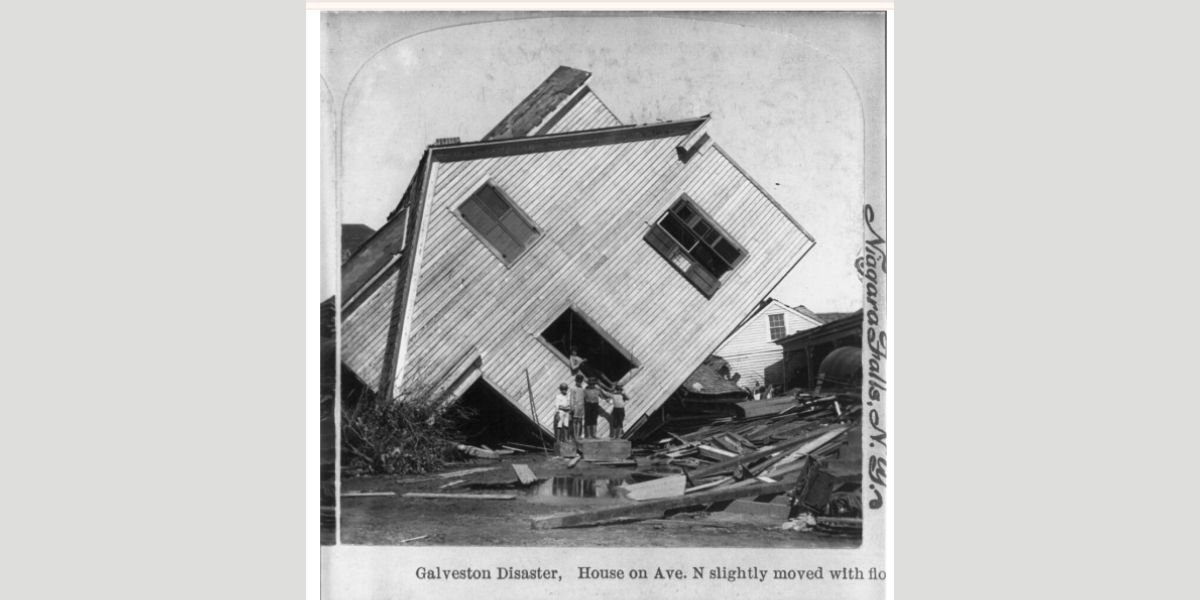
The Gulf and the Bay met across the island. Galveston stopped being land. Houses began to move. Whole blocks.
The clothesline at St. Mary’s
On the west end, at St. Mary’s Orphan Asylum, ten Sisters of Charity of the Incarnate Word had about ninety children, ages two to thirteen.
The water took the first floor. Then the second.
Sister Elizabeth Ryan and the others took clothesline and tied the children to their own waists. Six to eight children to a nun. If the building went, no child would go into the dark alone.
The building went.
Every nun died. All but three of the children died. The three were teenage boys whose ropes gave way. They held an uprooted tree more than a day.
One survivor, Frank Madera, was asked about that night thirty-seven years later.
He said he heard one terrible, solid scream of a hundred children. He said he could not sleep when it stormed.
The sisters were found on the beach still tied to the children they would not let go.
The historical marker is still on that ground.
Houses cried
A six-year-old named Clarence LaCoume sat with his family in the upper floors of their bakery and listened.
He lived.
Decades later his granddaughter Linda Macdonald asked him what he remembered. He stared forward and did not look at her.
He said the sound was horrible. Wind. People. And the crying of the houses.
She told him houses do not cry.
He said that night everyone, everything cried. A thousand demons in the dark.
Children calling for mothers. Women screaming. Men begging God. The voices got louder as someone floated past the building. Then they cut off.
And he knew someone had died.
That cut-off is the sound of September 8, 1900.
Watch the documentary
A page can hold the dates. It cannot hold the scream Frank Madera never stopped hearing.
The film from Old America Was Insane walks the same night: Havana’s warning, Moore’s ban, Cline’s house, the orphanage ropes, the pyres on the beach.
Cline’s house and the trestle
About 8:30 that night a piece of railroad trestle, riding the surge like a ram, hit Isaac Cline’s house.
The house came down. Cline went under. He later wrote that he opened his lungs and got ready to die.
Lightning. His six-year-old, Esther, in the water. He caught her. Another flash: Joseph holding the two older girls on wreckage.
They drifted three hours in the dark.
Cora was not with them.
Her body was found on October 3, under the house she had trusted.
The man who told Galveston a hurricane could not destroy it lost his wife in the wreck of his own walls. He lived until 1955. He spent the rest of that life on storms. NOAA still tells his file.
The lesson cost him everything.
The sea would not keep the dead
Sunday morning the wind fell. The water went out.
What it left does not fit a clean sentence.
Galveston papers listed 4,263 identified dead. Historians put the true number between six thousand and twelve thousand. Nearly one resident in four.
Whole families gone from the city directory overnight. The Allison household. An Adameit mother and seven children. Houses with no one left to file a name.
There were not enough coffins. Not enough ground.
The city loaded more than a thousand bodies on barges, weighted them, and put them in the Gulf.
The next morning the tide brought every one back to the beach.
The sea would not keep them.
So Galveston built pyres on its own sand and burned its dead for weeks. Smoke hung for a month. Men forced onto those fires were given whiskey by the city, just to stand it.
Clara Barton’s last field
Clara Barton was seventy-eight when the news reached her. She had founded the American Red Cross. Galveston was her last catastrophe on the ground.
She arrived nine days later and stayed two months. She pushed supplies toward Black survivors in a city that did not want that equality. The storm had killed Black and white in grim proportion. The relief did not, until she made it.
She left sick. She never led a field operation again.
The wall that proved the night did not have to happen
The survivors did not abandon the island.
They poured a concrete seawall seventeen feet high along the south shore, curved to throw the wave up and break it. They pumped about seventeen million cubic yards of sand from the floor of the sea and raised the grade under more than two thousand buildings. Churches and mansions went up on jacks while families still lived in them.
In 1915 another hurricane hit with wind and water in the same brutal class.
The death toll in the protected city was eight people.
The wall worked. The raised ground worked.
A comparable storm, fifteen years later, killed a handful instead of a city. That is the sentence almost no textbook prints.
Houston, fifty miles inland, took the port. Investors moved. Galveston became a quieter island. Chicago burned and told its story for a hundred years. Galveston drowned and went quiet. Families stopped talking. For decades the 1900 Storm was silence, not civic memory.
The government that shut the Cuban wire and banned the word hurricane set a chain that killed thousands of Americans. Then history, as it does when the powerful own the failure, moved on.
Old America was insane.
The same country later hid a daughter in an operating room and called poison liquor a good job. More are on Stories. The family chapter is Rosemary Kennedy. Who we are is on About.
If a date here is wrong, write oldamericainsane@gmail.com. It will be corrected in public.
Sources
- NOAA / NWS heritage — Isaac Cline
- Gilder Lehrman — Galveston Storm of 1900
- Origins / Ohio State — 125 years after the storm
- St. Mary’s Orphan Asylum marker
- Erik Larson, Isaac’s Storm (Weather Bureau, Moore, Cuban wires)
- Rosenberg Library / Galveston and Texas History Center survivor files