Two Movements, One Name: The Bald Knobbers of the Ozarks
On the morning of May 10, 1889, armed guards filled the jail yard in Ozark, Missouri.
Inside a closed enclosure stood a scaffold built for three men. Dave Walker. His son William. John Mathews. Only a handful of witnesses were allowed inside.
When the trap fell, the ropes stretched so far the men’s feet touched the ground. One report says William Walker’s rope broke. He lay on the ground until the sheriff and his deputies lifted him back onto the scaffold and hanged him a second time.
These three men had belonged to a movement that began with a promise to restore law and order in the Ozark hills. That promise ended on a scaffold the sheriff had built himself.
The name on the movement was the Bald Knobbers. Most retellings treat it as one group. It was not. There were two.
The war that never left the hills
Missouri never left the Union. The hills along the Arkansas line still saw a different war from the great battlefields back east.
Guerrilla bands, militia companies, and plain bandits rode through Taney County and its neighbors. They stole horses, burned homes, and settled private grudges under the cover of a cause. Forsyth, the county seat, was burned during the war.
When the shooting stopped in 1865, the loyalties stayed. Years later the men who became Bald Knobbers were mostly Union men, many of them recent arrivals with dreams of railroads, new towns, and rising land values. Most of the men who came to oppose them had sided with the South.
Two decades after Appomattox, Taney County was still divided along the lines the war had drawn.
A storekeeper and a newcomer
Many people there believed the law simply did not work. Stories circulated of killings that went unpunished year after year. Some of those claims were probably exaggerated. The belief itself was real, and it had consequences.
On September 22, 1883, James Everett, a Forsyth storekeeper by most accounts, was murdered. For a group of local men his death became a symbol of everything wrong with the county.
One of those men had arrived that same year. Nathaniel Kinney. Born in New York, he had served as a Union soldier, then spent years in Kansas, where newspapers remembered him more as a brawler than a pillar. In Taney County he remade himself. He organized a Sunday school and sometimes preached there. He even ran for the state legislature as a Democrat, and lost. Most of the men who would soon follow him were Republicans.
Later legend would make him nearly seven feet tall. Descriptions from his own lifetime put him somewhere between six foot two and six foot five. Enough to fill a room.
Snapp’s Bald
In late 1884 or early 1885 Kinney and a small group of local men formed what they called a citizens’ committee.
These were not poor farmers. They were merchants, prosperous stock raisers, doctors, lawyers, and politicians. They wanted crime stamped out. They also wanted something else: to break the hold of the Democratic officeholders who had run the county courthouse for years, and to make Taney County attractive to investors and settlers.
In the spring of 1885, according to later accounts, around a hundred men met on a treeless hilltop north of Kirbyville called Snapp’s Bald. Locals called hills like that bald knobs. The men who gathered there became the Bald Knobbers.
The jail and the oak tree
Their first recorded act of violence came almost immediately.
Frank and Tubal Taylor were brothers with a reputation for trouble. After a dispute with a storekeeper named John Dickenson, they shot him and his wife at Taneyville. Both survived. The brothers ended up in the Forsyth jail.
On the night of April 15, 1885, armed men broke into that jail, took the Taylors out, and hanged them from an oak tree a few miles outside town. Accounts of the lynching say a warning was left with the bodies, promising more would follow.
Some neighbors were glad to see the Taylors gone. Think about what had just happened. A group that claimed to stand for the law had begun its public life by breaking into a county jail and killing two prisoners who had never been tried.
That contradiction followed the Bald Knobbers for the rest of their existence.
Coggburn, then a truce that did not hold
Over the following months, night riders carried out whippings and threats across the county. Historian Matthew Hernando, who wrote the most detailed modern study of the group, found that they drove out people they considered criminals or vagrants, and sometimes their political opponents as well.
One critical newspaper report from late 1885 listed people it said had been forced out of the county, including a local justice of the peace. That report came from the vigilantes’ critics and should be treated carefully. It shows how the Bald Knobbers looked to the people on the receiving end.
Then, on February 28, 1886, the tension turned deadly again. Nat Kinney shot and killed Andrew Coggburn, a young man who had been an outspoken critic of the vigilantes. Accounts say Kinney claimed self-defense. For the Bald Knobbers’ enemies it was the moment silence was no longer an option.
After Coggburn’s death the opposition organized. They called themselves the Anti-Bald Knobbers and appealed to the state. Governor John Marmaduke sent his adjutant general, James C. Jamison, to Forsyth in April 1886. Jamison heard both factions, brokered a truce, and the Taney County Bald Knobbers agreed to disband.
On paper the experiment was over. In reality the killing continued.
In May 1886 a Bald Knobber named George Washington Middleton shot and killed Sam Snapp, a friend of Coggburn’s, in Kirbyville. In the elections later that year men from the Bald Knobber faction won control of the county offices. The vigilantes no longer needed midnight rides. They now held the courthouse itself.
How large had the movement grown? Some estimates put it at around nine hundred men across three counties. No reliable membership roll survives. Hernando could identify only a few dozen Taney County members by name.
Watch the documentary
A page can name the two counties. It cannot show the hilltop, the jail, or the scaffold the sheriff built himself.
The film from Old America Was Insane follows both movements, and the hanging that closed one of them.
The other Bald Knobbers
By then the name had already crossed into Christian and Douglas counties to the north. Here the story takes its sharpest turn. The northern groups were almost the opposite of the original.
In Taney County the leaders were men of property who welcomed progress. In Christian and Douglas counties Hernando found that roughly nine in ten members made their living from farming, most were poor, and very few held any public office. Many were devout evangelical Christians. Ministers were among their leaders.
They did not welcome change. They drove off homesteaders who competed with them for land. They pressured railroad agents to give better terms to the local men who cut railroad ties by hand. They also punished behavior they saw as sinful: illegal saloons, gambling, adultery, and men who abused or neglected their families.
Their leader in Christian County was a man named Dave Walker.
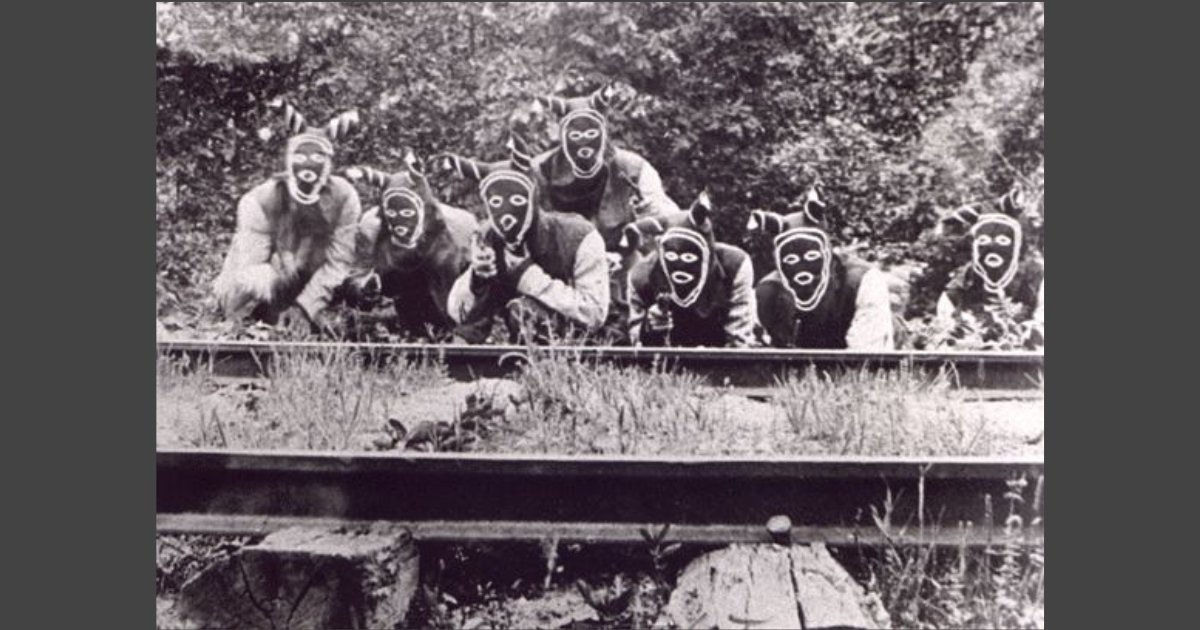
Historians also link this northern group to the image that still haunts the name: a black hood with two horns, the eyes and mouth outlined in contrasting thread. When people today picture the Bald Knobbers, they are usually picturing the northern movement, not Nat Kinney’s merchants and lawyers.
The cabin near Chadwick
On the night of March 11, 1887, that northern movement committed the crime that would destroy it.
Somewhere between twenty and thirty Christian County Bald Knobbers met at an old smelter site in a ravine near Chadwick. According to the Missouri Supreme Court’s later account, most were armed and masked. Switches had been gathered for whippings. The men spent two or three hours talking and initiating new members.
One family nearby, the Edenses, had voiced disapproval of the Bald Knobbers. Later accounts say young William Edens had insulted the group that very day.
When the meeting broke up, most of the men headed toward William Edens’s house. Dave Walker’s role became a central question at trial. Later accounts sympathetic to him say he tried to call the men back. A prosecution witness swore that he ordered the attack. The defense fought to discredit that witness. His son Billy, the group’s assistant chief, went along armed and masked.
Finding William’s house empty, they moved on to the one-room cabin of his father, James Edens. Asleep inside were James and his wife, their son William and his wife, their daughter and her husband Charles Greene, and two small children.
The masked men smashed the only window, fired into the cabin, and broke down the doors. The family fought back with pistols. Billy Walker was wounded. When it was over, William Edens and Charles Greene were dead, and James Edens lay badly injured.
Trials, then the founder’s death
Whatever patience some neighbors had shown toward whippings was gone. Christian County authorities moved quickly. In the trials that followed, prosecutors dropped charges against some accused men so they could testify for the state. In time roughly eighty men faced charges for a range of crimes. Federal authorities charged several dozen Bald Knobbers with intimidating homesteaders.
Four men were sentenced to death for the Edens cabin killings: Dave Walker, Billy Walker, John Mathews, and Wiley Mathews. In November 1888 the Supreme Court of Missouri upheld Billy Walker’s conviction, and it later affirmed his father’s as well. Wiley Mathews eventually escaped from the Ozark jail and was never recaptured.
Back in Taney County the old feud reached its founder. On August 20, 1888, an Anti-Bald Knobber named William “Billy” Miles shot Nat Kinney dead inside a general store in Forsyth. Miles was taken into custody, then released on bail to await trial.
May 10, and the Fourth of July
In 1889 defense lawyers made a last appeal. Even the trial judge and the prosecuting attorney asked the governor to commute the sentences. On May 8 Governor David Francis refused. In a letter he pointed to the masked men who had invaded a sleeping family’s home at night, and he described Dave Walker as a leader whose authority over the band could have prevented the attack.
Two days later came the hanging in Ozark, and a scene that wire reports carried to newspapers as far away as Nebraska.
The bloodshed was not finished. On the Fourth of July, Billy Miles and his brother James attended an Independence Day picnic near Kirbyville. Taney County Sheriff Galba Branson, himself a Bald Knobber, confronted them, along with a private detective named Ed Funk, who had allegedly been hired by Bald Knobbers to avenge Kinney. A gunfight broke out. Branson and Funk were both killed.
Billy and James Miles were later tried. In 1890 both were acquitted. With that the Bald Knobber era effectively came to a close.
Thirteen names, then a novel
Hernando counts at least thirteen people who died as a direct result of Bald Knobber activity.
Six were victims of the vigilantes: Frank and Tubal Taylor, Andrew Coggburn, Sam Snapp, William Edens, and Charles Greene. Six were Bald Knobbers themselves: George Washington Middleton, Nat Kinney, and Galba Branson, who died by gunfire, and Dave Walker, Billy Walker, and John Mathews, who died on the gallows. The thirteenth was Ed Funk.
How many others were whipped, threatened, or quietly driven from their homes, no record can tell.
Within a generation fiction began to replace memory. Harold Bell Wright’s 1907 novel The Shepherd of the Hills cast the Bald Knobbers as simple outlaws. Its success helped spark a tourism boom around Branson. Later a hillbilly music show borrowed the name, and a theme park ride blamed them for a village fire that never happened.
The real history is more unsettling. In one county a group of respectable businessmen took the law into their own hands, then took the courthouse too. In the next county over, poor and pious farmers did the same thing for the opposite reasons, and ended up killing the neighbors they claimed to be protecting.
Both movements began by saying the law had failed them. The original group formally agreed to disband, but its political influence outlasted the organization. The northern group was broken by the courts and the gallows.
Today, on the courthouse grounds in Ozark, a historical marker says plainly that it does not commemorate the violence. It was placed so that people would remember, and not repeat, what happened.
Old America was insane.
More on Stories. Another place the law failed the people it was meant to protect: Galveston, 1900. About.
Wrong date? oldamericainsane@gmail.com.
Sources
- Matthew J. Hernando, Faces Like Devils: The Bald Knobber Vigilantes in the Ozarks
- Contemporary newspaper accounts of the May 10, 1889 hanging in Ozark
- Missouri Supreme Court records on the Walker convictions
- Bald Knobbers — overview