The Johnstown Flood of 1889: The Lake Above the Town and the Club on the Mountain
Fourteen miles above Johnstown, Pennsylvania, there was a lake. It was beautiful, and it was stocked with fish, and along its shore stood the summer cottages of some of the wealthiest men in America.
Below that lake, in a valley so narrow the town had nowhere to grow but up the hillsides, lived the families who worked in the steel mills.
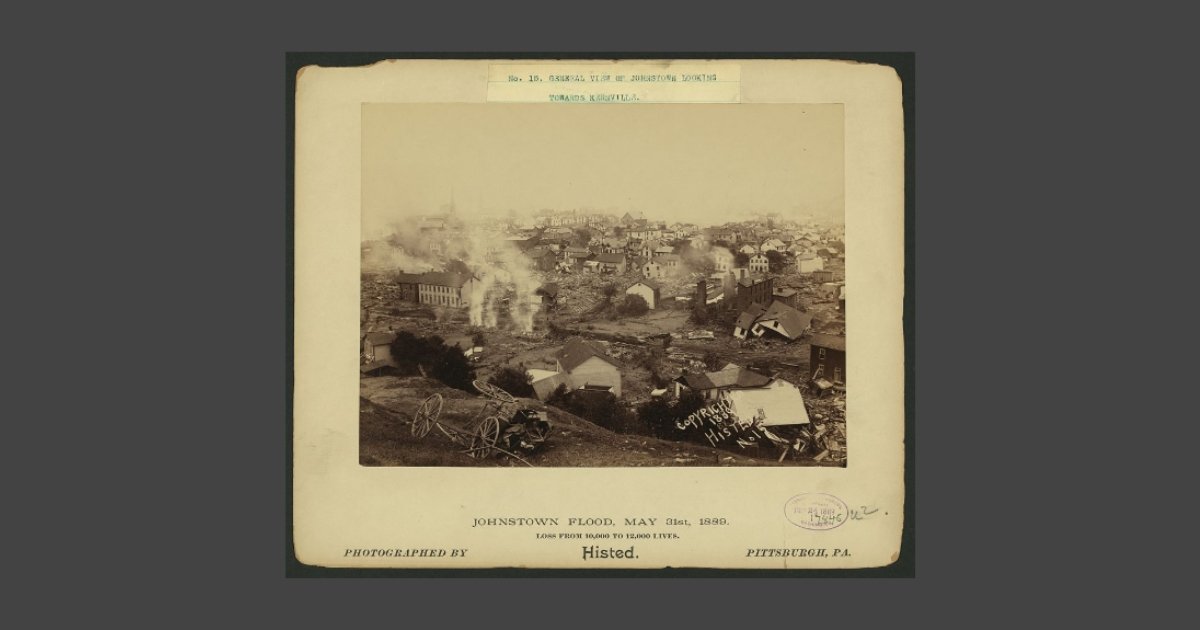
On the afternoon of May 31, 1889, the dam holding that lake gave way. In less than an hour, a wall of water reached the valley.
The official count of the dead was 2,209. Warnings had reached the town that very day. Concerns about the dam had been raised years earlier. And when the families of the dead went to court, not one member of that club was ever held legally responsible.
This is the story of Johnstown, and the club on the mountain.
A Town Built Where the Water Always Came
Johnstown sat where two rivers met — the Little Conemaugh and the Stonycreek — in a valley so narrow the town had nowhere to grow but up the hillsides. Around 30,000 people lived in the town and the communities around it. Most of them depended on the Cambria Iron Company, one of the biggest steel producers in America.
Many families were German, Welsh, and Irish. Fathers worked the mills, and children walked to brick schoolhouses beside the river. And every spring, the rivers rose.
Floods were so common that many families simply carried their furniture upstairs each year and waited for the water to go down. That habit matters. Because on May 31, many people had already lived through floods that turned out to be nothing more than wet carpets and muddy streets.
They had no reason to think this one would be different.
The Dam That Outlived Its Purpose
The South Fork Dam was built by the state of Pennsylvania to feed a canal, and it was finished in 1853. Within a few years, the railroads had made that canal useless, and the dam was left to decay.
In 1862, it partly failed. In 1875, a former congressman named John Reilly bought the property and removed its five iron discharge pipes — the only way to lower the lake on purpose in an emergency.
Then he sold it to a group led by a man named Benjamin Ruff, who turned it into a private summer retreat for wealthy Pittsburgh families. They called it the South Fork Fishing and Hunting Club.
Its members included Andrew Carnegie, Henry Clay Frick, Andrew Mellon, the future attorney general Philander Knox, and railroad official Robert Pitcairn. The club never replaced those pipes. It lowered the top of the dam to widen a road across it. And it placed fish screens across the spillway, so its stocked fish couldn’t escape into the river.
The Warning That Came Nine Years Early
The warnings didn’t only come on the last day. Daniel Morrell, the head of Cambria Iron, was worried about that dam. In November 1880, he sent an engineer named John Fulton to inspect it.
Fulton’s report warned that there was no way to drain the lake for repairs, and that leaks couldn’t be properly fixed. Morrell sent the report to Benjamin Ruff.
Ruff wrote back that Morrell and his people were in no danger from the club’s enterprise. The repairs were never made.
And down in the valley, the fear slowly became part of ordinary life. Years later, a survivor named Victor Heiser remembered how people thought about it. Some day, they told themselves, that dam will give way. But it won’t ever happen to us.
Two Days of Rain
On May 30 and 31, 1889, one of the heaviest storms anyone in the region could remember swept across western Pennsylvania. Estimates of the rainfall run from about six to ten inches.
By the morning of the 31st, parts of Johnstown were already under several feet of water. Up at the lake, the club’s president, Elias Unger, gathered workers to try to save the dam.
A young engineer named John Parke, who was at the club working on another project, joined them. They tried to cut a new spillway. They tried to raise the top of the dam.
According to later accounts, debris caught in the fish screens and choked the old spillway. It wasn’t enough.
Parke rode down to the town of South Fork, and warnings were sent down the telegraph line. The National Park Service says those warnings reached Johnstown three times that day. But people had heard warnings like these before, and most of them stayed home.
3:10 in the Afternoon
Around ten minutes past three in the afternoon, according to most accounts, the South Fork Dam failed. The National Park Service estimates that about twenty million tons of water poured into the valley.
The flood tore through South Fork, Mineral Point, and East Conemaugh, gathering trees, houses, railroad cars, and miles of wire along the way. Near East Conemaugh, a railroad engineer named John Hess saw the water rising and told his fireman the lake had broken.
He raced his locomotive toward the rail yard with the whistle screaming the whole way — a sound many people later remembered as their only warning. At seven minutes past four, the water reached Johnstown.
Three People in the Water
Victor Heiser was sixteen. His father had sent him out to the barn to untie the horses, so they could swim if the water rose. From the barn, Victor saw the flood coming.
His parents didn’t survive. Victor rode the wreckage through the town and lived. He grew up to become a doctor who worked in public health around the world, and he lived to ninety-nine. He’s buried beside his parents in Johnstown.
Gertrude Quinn was six. Her father had worried for days that the dam would burst. That afternoon, she found herself floating alone on a mattress as darkness fell, until a man named Maxwell McAchren fought through the water and reached her.
And downtown, Hettie Ogle, the manager of the Western Union office, kept sending messages as the water rose around her house. Her final message, according to the National Park Service, was simple: This is my last message.
She didn’t survive. Neither did her daughter, Minnie, or the two young women who worked beside her. Later, her son found her keychain near the stone bridge.
The Stone Bridge
That stone railroad bridge, just below the town, held. But everything the water carried piled up against it — houses, rail cars, timber, and wire.
That evening, the great pile caught fire, and some people trapped inside couldn’t be reached in time.
In the weeks that followed, many of the dead were never identified. More than 750 of them rest today in a section of Grandview Cemetery called the Plot of the Unknown.
The official list of the dead, printed more than a year later, named 2,209 people. Ninety-nine entire families were lost. Three hundred and ninety-six of the dead were children under ten. Ninety-eight children were left orphans.
And the National Park Service believes the true toll was probably well over 3,000, because some victims were never counted at all.
Clara Barton Comes to the Valley
On June 5, a sixty-seven-year-old woman arrived in the ruined valley. Her name was Clara Barton. She’d founded the American Red Cross eight years earlier, and it had never faced anything like this.
Johnstown became its first major peacetime disaster relief effort, and Barton stayed until October, organizing supplies and building temporary shelters so families had a roof again. Donations came from across the country and from overseas.
Andrew Carnegie, one of the club’s members, paid for a new library in Johnstown. Whether gifts like that came from guilt, duty, or simple charity, the record doesn’t say. Today, the Johnstown Flood Museum stands inside that old Carnegie library building.
The Lawsuits That Went Nowhere
Then came the lawsuits. Families who’d lost everything took the club and some of its members to court. None of those cases succeeded.
The club was a corporation with few assets of its own, and the disaster was widely treated as an act of God. The National Park Service puts it plainly: the club was never held legally responsible, although it was held responsible in public opinion.
The only successful flood cases were brought against the Pennsylvania Railroad. And John Fulton, the engineer who’d inspected the dam back in 1880, said afterward that he had told them the dam would break sometime and cause just such a disaster as this.
What the Engineers Found a Century Later
For more than a century, the official engineering view was that the club’s changes hadn’t really mattered. In 2016, a team led by geologist Neil Coleman at the University of Pittsburgh at Johnstown studied the dam again.
They found that the original dam — with its higher top, its spillways, and its five discharge pipes — could release more than twice as much water as the dam the club rebuilt. In their view, it likely wouldn’t have overflowed at all.
Others still debate it. But it’s worth sitting with what that finding means. According to that study, the men on the mountain may have taken a dam that would have held and turned it into one that couldn’t.
What Is Left Today
Today, the remains of the South Fork Dam stand inside the Johnstown Flood National Memorial. The wealthy members went home to Pittsburgh.
The town below buried its dead, rebuilt its streets, and went back to work in the mills. The courts never called the men on the mountain guilty.
And the valley never stopped asking why.
Old America was truly insane.
Watch the Documentary
This article is based on our full documentary on the Johnstown Flood. If you want to see the photographs, the survivor accounts, and the dam site as it looks today, watch it here:
The Johnstown Flood: 2,209 Dead and No One Was Ever Found Guilty →
If this story stayed with you, share it with someone who loves forgotten history. And if your own family has a story from the valley, we’d like to hear it — you can reach us through our contact page.
Sources
- National Park Service, Johnstown Flood National Memorial — Frequently Asked Questions and The South Fork Dam
- Neil M. Coleman, Uldis Kaktins, and Stephanie Wojno, “Dam-Breach hydrology of the Johnstown flood of 1889 — challenging the findings of the 1891 investigation report,” Heliyon 2(6), 2016 — doi.org/10.1016/j.heliyon.2016.e00120
- American Society of Civil Engineers, Report of the Committee on the Cause of the Failure of the South Fork Dam, 1891
- David McCullough, The Johnstown Flood (Simon & Schuster, 1968)
- Victor Heiser, An American Doctor’s Odyssey (1936)
- Heritage Johnstown / Johnstown Flood Museum, Grandview Cemetery and Plot of the Unknown records